End-to-end character animation across diverse tasks, no skeleton intermediates required.
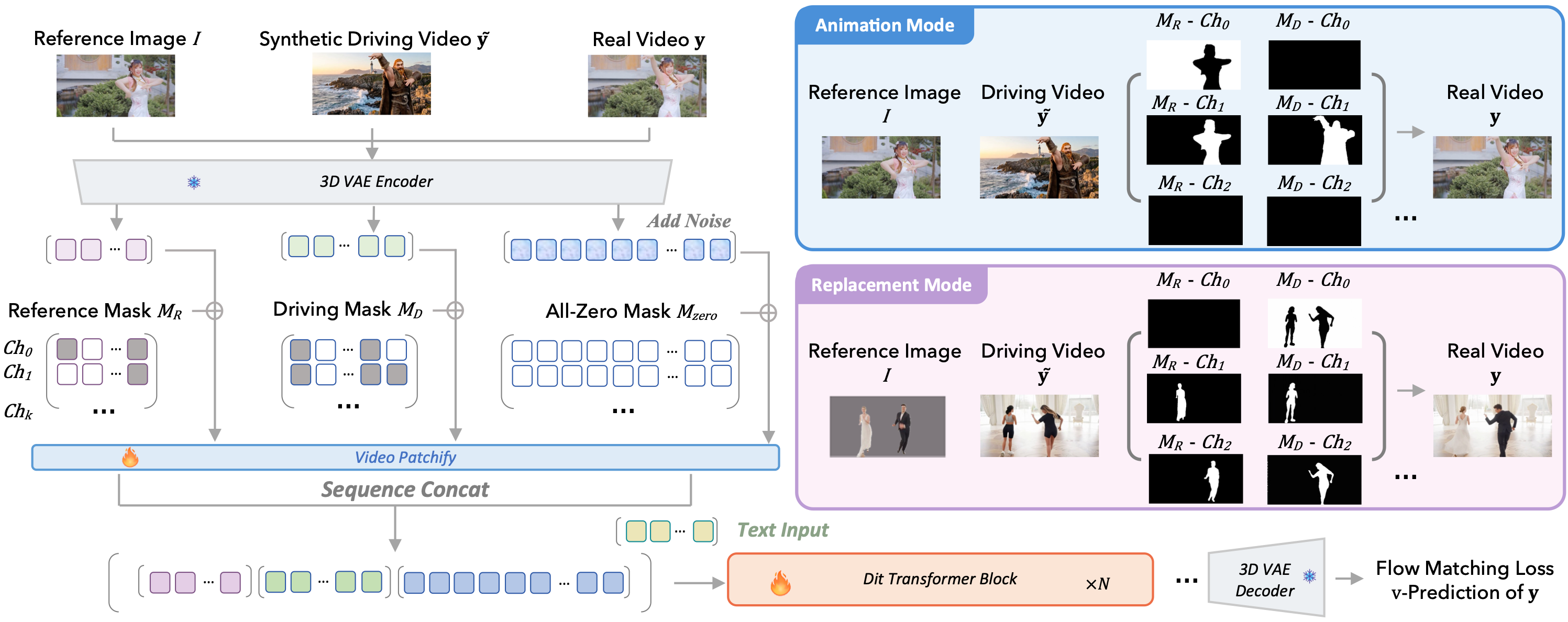
Controlled character animation aims to transfer motion from a driving sequence to a reference character. Prior works heavily rely on intermediate representations, such as pose skeletons for motion and masked backgrounds for environment, inevitably resulting in information loss. In this work, we present SCAIL-2, a framework that adopts the end-to-end driving paradigm by directly concatenating latent visual information to the model's input sequence. We enable end-to-end training through a data synthesis pipeline that produces MotionPair-60K, a curated dataset for several character animation subtasks. We unify the subtasks using decoupled conditions to accommodate different driving patterns, facilitated by In-Context Mask Conditioning and Mode-Specific RoPE, which provide soft guidance beyond textual instructions and visual information. To address synthetic discrepancy in detailed regions, we propose Bias-Aware DPO to construct preference items to mitigate the errors. Extensive experiments demonstrate that our method achieves state-of-the-art performance across various character animation tasks.
SCAIL-2 builds a unified motion transfer interface on top of a latent video diffusion model, replacing brittle skeleton intermediates with direct visual conditioning.
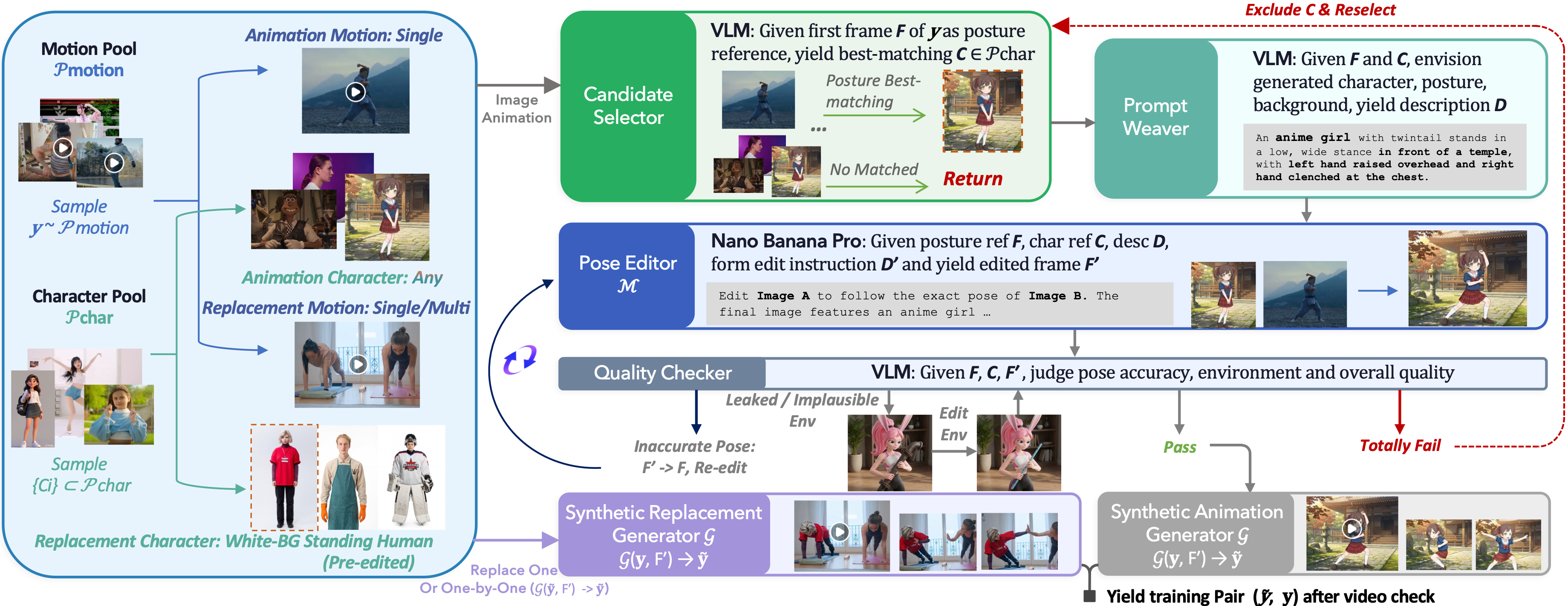
Agentic data synthesis pipeline for MotionPair-60K
Unified in-context conditioning with mode-specific RoPE
We use SCAIL-Preview, Wan-Animate, and MoCha as generators in the generation pipeline to synthesize 60K heterogeneous motion pairs spanning animation, replacement, and multi-character tasks.
Two masking channel types, consisting of an environment switch and character binding slots, enable task unification with proper guidance.
Dedicated RoPE position encodings per task mode allow a single model to correctly route spatial-temporal attention across animation and replacement.
A post-training DPO scheme targets synthetic-data bias concentrated in fine-grained regions (especially hands/fingers), improving end-to-end motion fidelity in detailed areas.
SCAIL-2 vs. state-of-the-art pose-driven animation methods or proprietary services. Each video shows multiple methods side by side.
When multiple people interact closely, depth-ambiguous overlapping skeletons cause misinterpretation in existing methods. SCAIL-2 handles interactions correctly end-to-end.
Replace a character in an existing video with a reference identity. SCAIL-2 achieves seamless environment integration and accurate motion without background-inpainting.
Because SCAIL-2 learns from visual context rather than skeleton semantics, it generalizes to driving sources that lie entirely outside the training distribution, including animal-driven animation, cross-embodiment motion transfer, and object motion transfer. It also exhibits emergent camera-following behavior under large camera motion.
@article{yan2025scail2,
title={SCAIL-2: Unifying Controlled Character Animation with End-to-end In-Context Conditioning},
author={Yan, Wenhao and Guo, Fengjia and Yang, Zhuoyi and Tang, Jie},
journal={arXiv preprint arXiv:2606.10804},
year={2025}
}
@article{yan2025scail,
title={SCAIL: Towards Studio-Grade Character Animation via In-Context Learning of 3D-Consistent Pose Representations},
author={Yan, Wenhao and Ye, Sheng and Yang, Zhuoyi and Teng, Jiayan and Dong, ZhenHui and Wen, Kairui and Gu, Xiaotao and Liu, Yong-Jin and Tang, Jie},
journal={arXiv preprint arXiv:2512.05905},
year={2025}
}